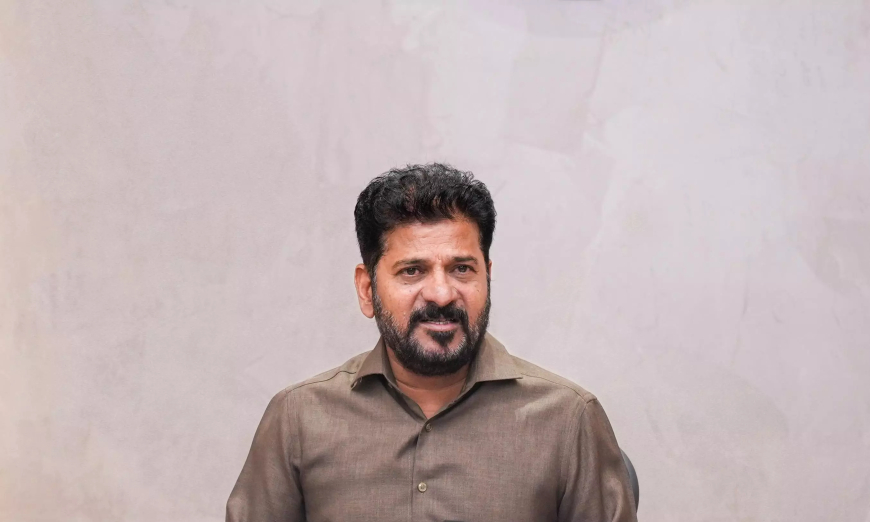
Chief Minister A. Revanth Reddy announced in the Legislative Assembly that a Special Enquiry Team (SET) will be constituted to investigate cases where lands were illegally grabbed using the Dharani portal as a cover. The CM gave a detailed explanation during a short-duration discussion in the Assembly on the 22-A prohibited list. The CM laid out before the House that land-related problems have arisen mainly under four categories over time, and said all instances of land grabbing that have come to light will be referred to the Special Investigation Team. He traced the history of land issues from the Nizam era through united Andhra Pradesh, the formation of Telangana, and up to the problems being faced today.
* The Chief Minister referred to land records dating back to 1908 and the various laws successive governments introduced up to 2011, along with the situations these created. He mentioned the Khasra Pahani of 1954-55, the abolition of the Inam Lands Act in 1955, Vinoba Bhave's Bhoodan movement, a 1965 law, the 1/70 Act relating to tribal and indigenous communities, the new ROR Act of 1989, and the system of issuing pattadar passbooks.
* He said the Land Ceiling Act was brought in 1973 after land became concentrated in the hands of very few people, and that in 1977 a law was introduced banning the transfer of assigned lands to prevent their alienation. The CM also noted that, to protect tribal communities in matters relating to podu lands, the UPA government introduced the Forest Act in 2006.
* The Chief Minister also detailed developments after Telangana's formation, up to the launch of the Dharani portal process in 2018. He explained how responsibility for the Dharani system was first given to IL&FS in 2018, and how it subsequently passed through the hands of companies such as Terasys and Falcon.
* He alleged that records of about 2.50 crore acres of land belonging to Telangana's farmers — including Aadhaar numbers, bank account numbers, and owners' phone numbers — were moved to Cameron Highlands. He alleged that, instead of digitizing revenue records as required, all the records were instead placed in the hands of foreign entities. He noted that a Land Grabbing Act had been brought in June 1982 in united Andhra Pradesh to curb land encroachments, but that the then government repealed that law soon after Telangana was formed, and questioned why it had been repealed.
* The Chief Minister told the House that disputes exist over 3,73,930 acres of private land. He said the Bhu Bharati Act was brought in 2025 to protect people's lands and resolve land-related problems. He said the Act was introduced as part of a comprehensive clean-up process, following discussions with all sections of society at all levels and placing the issues in the public domain, in order to prevent the irregularities committed in the name of Dharani and protect people's properties.
* The Chief Minister clarified that his government did not introduce Section 22-A relating to prohibited lands. He said Section 22-A was first introduced back in 1999, during the united Andhra Pradesh period, with the purpose of protecting Bhoodan, Waqf, endowment (Devadayam), and government lands.
* He said the Full Bench had ruled in December 2015 that prohibited lands should be classified clause-wise, and that disputes subsequently arose from transactions and developments linked to issues such as the cut-off date. He said the problem was compounded because, whenever a dispute existed in one part of a survey number, the entire survey number was added to the prohibited list. As a result, disputes that originally stood at about three lakh acres grew to 30 lakh acres.
* The Chief Minister said that as of October 2020, 7,91,542 acres were on the prohibited list, and that after the People's Government came to power, this was brought down to 3,73,930 acres. He said disputed lands under Part-B were similarly reduced to 17 lakh acres. He noted that although the 22-A prohibited list was updated as far back as last December, many people had not noticed this.
* The Chief Minister made clear that eight key issues mainly need to be resolved with regard to the prohibited list. He clarified that the prohibited list has continued since the united Andhra Pradesh period, and that the People's Government has not added any new lands to it.
* He said that, going forward, only the concerned Collector will have the authority to decide whether any land should be added to the 22-A prohibited list. He explained that such a decision will be taken only after examining the objections and records of the concerned person and conducting an inquiry. He said that if a person is dissatisfied with the decision, they will be given the option to appeal within 60 days, followed by the option to file a revision petition within 90 days.
* The Chief Minister said that Devadayam and Waqf records will be examined to determine the status of such lands. He said that if only a portion of such land is under dispute, only that portion will remain on the prohibited list while the rest will be removed from it.
* He said the government decided to take up this discussion in the Assembly specifically because of the doubts among the public regarding the prohibited list. He noted that the government had already planned to discuss key issues such as fee reimbursement, education, the El Niño effect, and drought conditions during the current session. He also mentioned that power consumption this season reached a peak demand of 19,500 MW in a single day, and said the government felt it necessary to discuss all such major issues.
* The Chief Minister said that after discussing these inherited problems in the Assembly, the government would certainly act on any necessary suggestions from the opposition to ensure no lapses occur going forward.
* He said that lands worth about one lakh crore rupees, which rightfully belonged to the poor in the state, had been grabbed. He said everyone bears a responsibility to bring out the facts in this matter, remarking that if this land grabbing is forgiven, future generations will not forgive it.
* The Chief Minister made clear that the government will not overlook cases of rampant land grabbing carried out using Dharani as a cover. He announced in the Assembly that all such cases will be referred to the Special Investigation Team and that a comprehensive inquiry will be conducted into instances of land grabbing.